In our exclusive Design Fiction series for France’s CB News, we dive into the future through imaginative storytelling: short, thought-provoking pieces that explore what’s next for industries like fashion, tourism, banking, and more. Inspired by real signals shaping our world today, each article examines the possibilities ahead and unpacks what they mean for brands, communication, and strategy.
dentsu X imagines tomorrow, today.
In this fictional scenario set in 2050, the word "new" disappeared from the vocabulary. Objects are no longer bought; they are transmitted, dismantled, reinvented. In homes and at certified assemblers, people assemble, adapt, create. Brands no longer sell products, but modules, assemblies, compatibility. The law has imposed the end of closed ecosystems; consumers have become artisans of their daily lives. And at the heart of this silent revolution, Cyclea keeps watch: the memory of each part, the traceability of each material, the compatibility of products, the promise that nothing ever dies.
What if, in the near future, your objects also had several lives to tell?
Date: 2056, Paris.
My name is Elio; I am a curator at the Museum of Early Objects.
I remember a time when objects died. A breakdown, a crack, an outdated model, and everything ended up in the trash. Today, this idea seems as absurd as throwing away a memory. Since the 2050s, nothing is new anymore — and this is undoubtedly the most beautiful silent victory of our century.
The Museum of Early Objects
Every year, schools bring their students to visit the museum whose collections I have been directing for more than 10 years now, the Museum of Early Objects. Under the display cases, old smartphones, kettles, laptops, all frozen in their closed shells. Fossils of plastic and glass. The children laugh when they discover that in the past, you couldn't open a machine without voiding the warranty.
They are astonished that a toaster could only be used to toast bread. For them, the idea of a single-use object belongs to folklore, much like phones without integrated AI or plastic bottles. But I remember. I remember the frustration of the "new" that ages too fast, of those rigid appliance aisles where each brand imposed its closed kingdom.
I remember the moment when everything started to tip over.
The time of fractures
Already in the early 2010s, cracks were opening. People were talking about the right to repair, refurbished goods were starting to appeal more and more, USB-C ports were asserting themselves over proprietary connectors under pressure from European legislation...
In their wake, fablabs dabbled in upcycling. A few pioneers appeared — Fairphone, Framework — precursors of durable technological products that hinted another narrative was possible.
Then came the rare metals crisis, soaring prices, shortages. The world began to look differently at the mountains of objects piled up in its landfills.
The Cyclea revolution
The rupture was named Cyclea. For a long time a simple eco-organization, in charge of collecting and recycling waste electrical and electronic equipment, it morphed into the silent infrastructure of our daily lives.
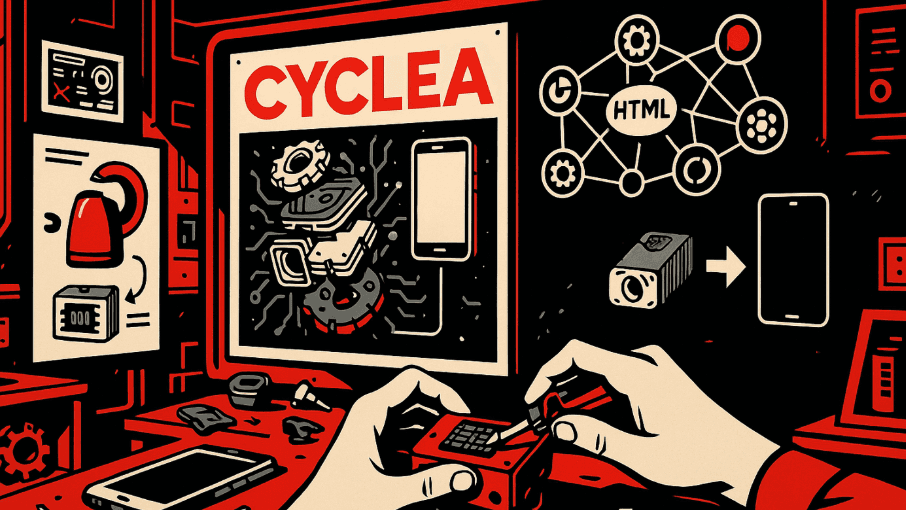
It created an open protocol, an HTML of matter, capable of connecting modules, motors, lenses, circuits to each other.
Thanks to this protocol, any part could converse with another, regardless of its origin. Cyclea checked the compatibility of connectors, the permissible electrical voltage between two parts, software connectivity, and ultimately guaranteed that the whole remained safe and stable.
Via its Cyclea.me app, a simple scan made it possible to know if a particular coffee maker module could be associated with a fan motor, or if a computer graphics chip could boost a video projector.
So, households started creating. The old smartphone turned into a mini-video projector thanks to a lens and a recycled LED block. The table vacuum cleaner became an air purifier thanks to a salvaged filter. The kettle which, equipped with a refurbished heating element and a connected module, metamorphosed into an essential oil distiller.
One day, a visitor to the museum confided in me: "My lamp was born from a hairdryer and a toaster. It is the only one of its kind. Hard to believe that in those days, a lamp remained... just a lamp."
Today, objects had therefore ceased to die: they could be reincarnated. At two levels: intra-product, from one vacuum cleaner to another, or inter-product: from a smartphone to a blender, for example.
And this is where Cyclea came into its own. Its network, a sort of "blockchain of matter," recorded the biography of each part: its origin, its reuses, its repairs, its upcycling. One could follow the trajectory of a simple vacuum cleaner motor that became a lamp, then integrated into an air purifier, before ending up, one day, in a light hydrogen car.
Objects no longer died; they migrated. They changed shape, function, sometimes continent.
They were, literally, alive.
When the law stepped in
Yet, without the law, this metamorphosis would never have taken place. After the repairability index, Europe imposed the compatibility index.
The more a brand persists in closing its ecosystems, the more it is penalized: fines, then sales bans. Consumers also pay an eco-compatibility tax, clearly displayed. The label turned hierarchies upside down: hype faded before transparency.
Public utility campaigns, financed by fines and taxes, took on radical tones. I remember this slogan plastered in 2036: "Your non-compatible coffee maker kills more than it heats."
Thanks to its various successive directives, the market economy had totally changed, and mentalities with it.
In 2050, "new" has now practically disappeared. Value is no longer in shininess, but in memory.
Objects have ceased to be possessions: they have become life companions, bearers of a collective narrative. Homes, workshops. Consumers, artisans. And Cyclea, the invisible infrastructure that guarantees that everything remains possible, traceable, reversible.
An intimate gallery in every home
Today, no interior looks like another. Two neighbors will never have the same coffee maker: at Alice's, it also acts as a Bluetooth speaker; at Malik's, it inductively charges his phone.
Buying an object is no longer buying a finished shape, but a reservoir of possibilities. Some carefully choose their modules, others let themselves be surprised by the assemblies offered by the local Cyclea stock.
Stores themselves have stopped selling "products." Instead, you found kits of possibilities. Modules classified not by function, but by compatibility, by energy, by material. The old aisles — beauty, cooking, DIY — have almost disappeared, swept away by a new paradigm: that of co-creation.
Brands put to the test of emptiness
Faced with this upheaval, brands first trembled. If objects are no longer finished, what remains of their power?
Some disappeared. Others mutated: Apple became a designer of premium modules, offering camera sensors or ultra-fast chips; Dyson transformed into an experience guarantor, certifying silent and efficient motors; Hermès turned into a curator of signature assemblies, recognizable at a glance.
And for consumers, the promise of being able to connect, combine, add brands and products, almost infinitely. Just as one already combines several brands in an outfit, objects are now adorned with multiple signatures. Some brands now boast of ultra-compatibility: "Compatible with over 500 modules!"
The day objects started talking
I kept an old motor module, inherited from my father.
One day, I scanned its Cyclea identifier: it had served in three generations of machines, from the hairdryer to the fan, before powering my desk lamp today.
On the screen, a simple message appeared:
"Thank you for extending my life."
The following Monday, I was back at the museum. Behind the glass, an old toaster was still waiting to be turned back on — closed block, without memory, without a future. I looked at it for a long time.
And I understood that this museum did not preserve objects... but the remains of an obsolescence that we had managed to deprogram.
Originally published in CB News, October 14, 2025: "The secret lives of objects."