In our exclusive Design Fiction series for France’s CB News, we dive into the future through imaginative storytelling: short, thought-provoking pieces that explore what’s next for industries like fashion, tourism, banking, and more. Inspired by real signals shaping our world today, each article examines the possibilities ahead and unpacks what they mean for brands, communication, and strategy.
dentsu X imagines tomorrow, today.
The aim of this Design Fiction exercise is to analyze how our society's weak signals could change if they were to become the norm in twenty or thirty years. This exercise is not intended to predict the future, but rather to understand how brands could adapt to, or even play a role in, these possible transformations.
In this fictional scenario, we have imagined a France whose population has become increasingly isolated in the comfort of the digital world. Human relationships mostly happen online, and it is easy to isolate oneself there. This becomes a real problem until the day a small group of enthusiasts decides to play "like before", together, around the same console. This simple gesture, driven by nostalgia and the need for presence, will become a national movement supported by the French state: that of the return of convivial video gaming, a rediscovery of social connection through the pleasure of playing side by side.
Date: 2055, France.
Going against the grain of the golden age of online entertainment, France has rediscovered the pleasure of playing side by side. Born from a small nostalgic collective, the "in-person video game" movement has established itself as an unexpected response to the crisis of social connection. Supported today by public authorities and major brands in the sector, it has transformed the way French people meet, interact, and share.
A connected society, but lonely
In 2055, France lives in a paradox: ultra-connected, yet profoundly isolated. Communication technologies have never been so efficient, and yet human relationships have never seemed so distant. Teleworking has become the norm in almost all service sector jobs, physical stores have given way to automated delivery, public meeting spaces have become scarce, and the majority of social interactions occur through digital platforms.
Social bonds have dissolved into the digital realm, whether on social networks, streaming platforms, forums, or video games. Individuals now all face a bubble effect that only exposes them to people and content similar to themselves, exacerbating the social divide that was already a problem at the beginning of the century.
Conviviality then seems to belong to another era, and video games are a perfect representation of this, since in 2050, 87% of players declare they "mainly play alone". Once an engine of connection and sociability, this medium has transformed into a refuge where people isolate themselves rather than seek to share something with others.
"The paradox is that we have never played so much — but never so little together," analyzes sociologist Alicia Brehier (School for Advanced Studies in the Social Sciences). "The video game, once a space for sharing, has become a tool for individual escape. Virtual worlds offer company without the constraint of presence."
While video games thus offer a form of comfort, they also allow us to lock ourselves into a form of soft and invisible loneliness that eventually takes its toll. It is in this flaw that a small group of enthusiasts will reintroduce a forgotten idea: playing, yes — but gathered together.
The Couch Collective: nostalgia as resistance
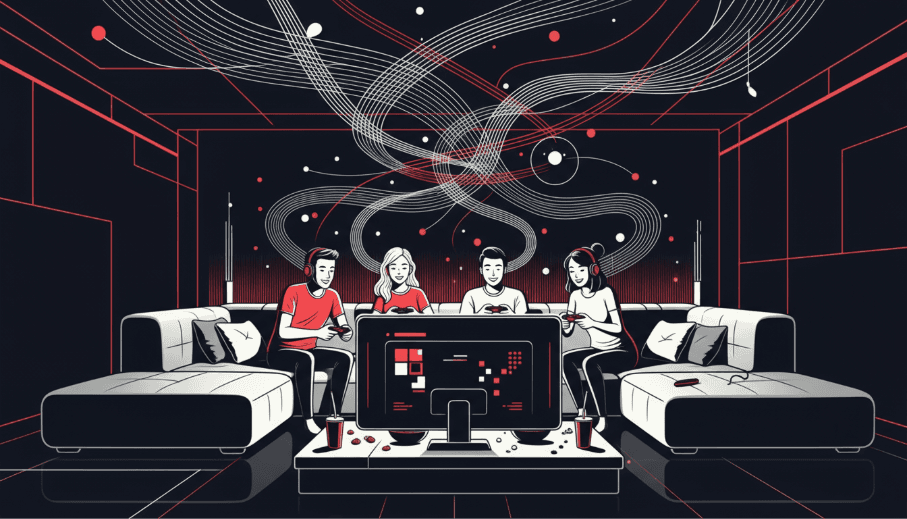
It all begins in Lyon, in 2048. A group of friends, all in their thirties, brings out an old console found among the belongings of one of their older brothers: The Wii. They have a simple goal: organize an evening "like before": One TV, four controllers, and pizzas. No headsets, no network, only the shared laughter when a friend makes a blunder, or the satisfaction of having been the best of the evening.
This banal moment becomes the starting point of an unexpected cultural movement. The collective gives itself a name — The Couch Collective — and posts videos of its evenings on YouTube. The contrast between their simplicity and authenticity versus the digital world is fascinating. Their videos are viewed millions of times, and especially by all types of communities, with nostalgia seeming to speak to everyone.
"The important thing is not necessarily that we are passionate about playing old games, but above all that we play together again," says Léo Garcia, one of the founders. "We had almost forgotten what it was like to laugh with someone else in the same room."
Gradually, similar groups emerge in other cities: Lille, Bordeaux, Toulouse, Nantes. Some of the remaining open bars organize "social retrogaming" nights, where people come to play or watch Esport competitions. It is no longer just a nostalgic trend: it is a way to reconnect.
In this era more connected than ever, this trend grows slowly but surely. So much so that by 2050, every major city has groups similar to the Couch Collective, related content swarms the French internet, and the majority of people know someone who has already attended such an evening. So, while the movement is not yet what it has become today, it has solid popularity, which has not escaped the government of the time, which is preparing to propel it into another dimension.
When the State joins the game
Faced with the rise in cases of isolation, the government takes up the issue. In 2051, the Ministry of Youth and Associative Life launches the Reconnection program, a national plan for "resocialization through gaming."
The initiative includes subsidies for local associations similar to the Couch Collective, aid for the creation of Collective Gaming Houses or Esport competitions, as well as grants for young studios working on physical multiplayer experiences. Municipalities are encouraged to reopen public halls dedicated to recreational activities, often set up in former sports facilities.
"For a long time, we financed stadiums to rebuild social ties," declares Sébastien Orphela, Secretary of State for Social and Ludic Connections. "Today, it's consoles. Collective gaming is our new sports ground."
Quickly, the practice spreads throughout the country. In villages, town halls equip communal rooms with repaired old consoles. In big cities, festivals gather thousands of visitors every year. Some municipalities go further, integrating collective gaming into their health and education policies, as a tool to prevent isolation and learn cooperation. Membership requests for associations explode, and waiting lists grow longer, leading to the creation of ever more new clubs.
Brands play the sharing card again
The video game market soon adapts. Ubisoft, the largest French video game studio, launches Free Time (Quartier Libre) in early 2053, a series of party games designed to be played solely with multiple people and in person. And some major competing publishers like Nintendo also start releasing games based on the same concept. Public subsidies boost the creation of French studios, which multiply rapidly over the following years, specializing in new styles of IRL multiplayer games.
Without abandoning major immersive titles, industry players are rediscovering an unexpected market: that of the simple pleasure of playing together in the same room. At festivals, Esport competitions transform: The conviviality and amusement that these events can provide take precedence over the performance of professional players, which attracts a new, more family-oriented audience.
A new culture of living together
In 2055, nearly two out of five households regularly participate in a collective gaming activity. Couch gaming nights have become social rituals, just like family meals or football matches. In schools, some teachers use these games to develop cooperation and conflict management. In retirement homes, they serve to maintain ties between generations.
Game design has also evolved. Developers favor physical interactions, shared laughter, and moments of improvisation. Gone are solitary quests: achievements are unlocked together. Some sociologists now speak of a "soft revolution of leisure," where gaming becomes a tool for connection, a common space for all generations.
The phenomenon has even gone beyond the recreational framework: companies now organize "couch breaks" to strengthen team cohesion, and some integration associations use collective gaming to rebuild trust.
Video games did not save French society. But they gave it back a common ground, an excuse to laugh, talk, and exchange. And in a fragmented country, that was perhaps already a lot.
Originally published in CB News, November 12, 2025: "Title The great return of convivial video gaming: when France plays together again."