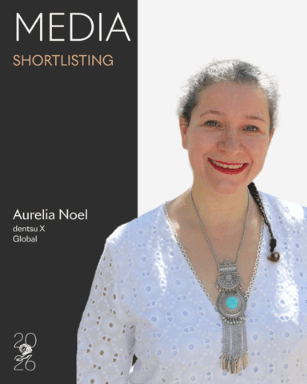
For the Cannes Lions 2026 awards program, I served as a judge on the Media Lions shortlist jury and as a member of the Young Lions Media competition jury. Now that judging has been completed, I’ve been asked to share my impressions and insights into the awards entry and judging processes.
Q: Having now experienced the judging process, what surprised you most?
Aurelia: What surprised me most was how much discipline sits behind great creativity.
From the outside, award-winning work can sometimes look effortless or even obvious. Reviewing hundreds of entries (258 to be exact) as a Media Lions shortlisting juror, I realized that the work I liked best, was about strategic clarity, anchored in a really human challenge. The winning ideas were rarely the most complicated. They were often the ideas where the media idea, the creative idea and the human challenge became inseparable. Serving on the Media shortlist jury gave me a new appreciation for just how high the bar really is, but also how diverse our industry truly is.
Q: Looking back across all of the work you reviewed, did anything change the way you think about great media or creativity?
Aurelia: If I had to summarize one learning, it's that media and creativity can’t be seen as separate crafts. Media should not be seen as a distribution system. It increasingly is the platform that brings the idea, the creativity to life.
The strongest entries didn't think of media as a “media” plan added at the end of the creative process. Media itself created participation, changed behavior, unlocked culture or made a brand experience tangible. It reinforced my belief that creativity doesn't happen in isolation. It emerges when creativity, culture, technology and media design work together to solve a real human and business challenge. In a world that is fragmented and heavily influenced by the algorithms, Media enables the brand story to take life, providing that every touchpoint (Owned, Earned, Shared or Paid) tells a connected story.
Q: Were there any common misconceptions or mistakes that you saw agencies making when entering their work?
Aurelia: The biggest mistake was assuming that a great campaign automatically makes a great Cannes entry.
Many entries had impressive results or strong creative assets, but they didn't clearly articulate why the media thinking mattered and why Media was a true differentiator. From my experience, a good entry starts with a Human Truth, and there is a difference between a Human truth and an insight. Another common issue was trying to make the same story fit multiple categories rather than tailoring the narrative to what jurors were actually looking for in that particular category. When you judge over 250 entries, you have 5mn to decide if it is worth moving to a shortlist so the case film and written submission matter enormously. Funnily enough, a well-articulated media story is often what was missed by many.
Q: What qualities did the strongest entries consistently demonstrate, beyond simply being creative?
Aurelia: A few things stood out for me as a juror and a judge on Young Lions.
- A Human challenge a brand has authority to solve.
- A good grasp on the place you can own in Culture
- An idea that drives talkability and the bottom line
- A campaign that scales and don’t just rely on a good idea.
The best work was often surprisingly human whether it was bringing a national dish to life, taking a stand on misinformation, making a societal problem visible to the many. You immediately connected, a good case for me was one that made me feel something, that stayed with me for days because it triggered something different. It also tended to create a role for the brand so they became good citizens of their own community. The strongest cases were not scared to stand for something different.
Q: Did judging challenge any assumptions you previously held about what makes an award-worthy campaign?
Aurelia: I probably entered the process thinking that innovation and tech would dominate more strongly than it actually did. I was really surprised to see how few cases used data and tech.
Instead, I found myself consistently rewarding ideas that created real value for people and businesses. Technology, AI and new platforms were often present, but they rarely won because they were technologically impressive. They won when technology amplified a powerful human truth or solved a genuine problem. That's an important distinction for all of us working in a period of rapid change. It really comforted me in the idea that advertisers fall in love with solutions, not tools.
Q: Was there a piece of work, trend or approach that made you think, "We'll be seeing a lot more of this in the future"?
Aurelia: The shift from audiences to participants. And the fact that brands are really starting to understand they need to let go of a polished and controlled image, to co-create with their communities.
Across multiple categories, the strongest work invited people to do something, contribute something, shape something or experience something. The line between content, experience, community and commerce continues to blur.
More broadly, I think we'll see a lot more work built around trust, even beyond authenticity. In a world increasingly shaped by algorithms, AI-generated content and synthetic experiences, brands that can prove, not just claim, their value will have a significant advantage. Trust is becoming a competitive asset.
Q: Has the experience changed the way you'll approach your own work or the advice you give to clients and teams?
Aurelia: I'll spend even more time pushing teams to define the problem before jumping to solutions. The judging process reinforced how often great campaigns come from asking the right questions and starting from a different viewpoint. Diversity of thoughts and background is a gift, we often take for granted.
It also strengthened my conviction that brands need to invest in distinctiveness, trust and cultural relevance. As AI reshapes discovery and attention becomes harder to earn, those fundamentals become more important, not less. My advice to clients will continue to be: build brands that people want to talk about, participate in and trust.
Q: If you could give agencies one piece of advice before they start planning next year's Cannes entries, what would it be?
Aurelia: Too many people think about Cannes as the ultimate destination, and I had entries that felt “made for Cannes.” The best work never feels like it was created for juries. It feels like it was created for people. If the idea drives meaningful impact, the case study story becomes much easier to tell. Before I even looked at the case film, I was after two things: (1) deep consumer insight, what is the human truth you used to build your campaign and how does it relate to your brand, and (2) scale of execution and impact, is your media plan credible enough to have delivered the impact you claim it had? I was also after campaigns where culture and commerce intertwined, a good campaign needs to have scale and commercial impact.
Q: Finally, if there's one lesson you'd like the wider industry to take away from this year's judging, what would it be?
Aurelia: Despite all the conversation about AI, automation and the future of marketing, the most encouraging thing I saw was that creativity remains profoundly human.
A few weeks before Cannes, I judged hundreds of entries for the Media Lions. During the festival, I also had the privilege of judging the Young Lions Media competition. What gave me the greatest optimism wasn't the technology. It was the talent.
The next generation of strategists, planners and creatives are bringing incredible passion, curiosity and craft to our industry. Combine that with the new tools now emerging, and I genuinely believe the next decade could be one of the most exciting periods our industry has ever experienced.
The future belongs to organizations that can combine human imagination with technological possibility. Cannes 2026 gave me every reason to believe that future is already taking shape.
Read Aurelia’s Cannes Lions jury bio here.
For more about dentsu @ Cannes, click here.