In our exclusive Design Fiction series for France’s CB News, we dive into the future through imaginative storytelling: short, thought-provoking pieces that explore what’s next for industries like fashion, tourism, banking, and more. Inspired by real signals shaping our world today, each article examines the possibilities ahead and unpacks what they mean for brands, communication, and strategy.
dentsu X imagines tomorrow, today.
The aim of this Design Fiction exercise is to analyze how our society's weak signals could change if they were to become the norm in twenty or thirty years. This exercise is not intended to predict the future, but rather to understand how brands could adapt to, or even play a role in, these possible transformations.
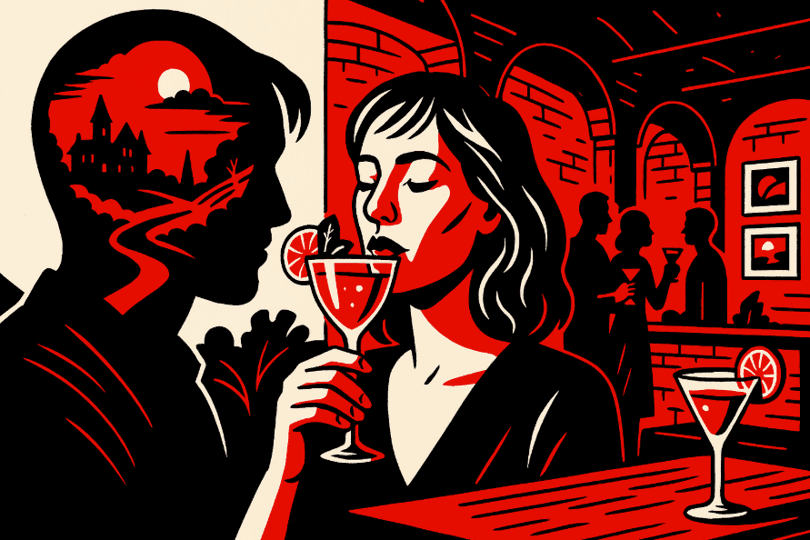
In this fictional scenario set in 2060, the accumulation of climate crises and sensory saturation have turned our lifestyles upside down: material possession has given way to the quest for intense and meaningful experiences. Travels are no longer simple trips, but emotional rituals, and every everyday gesture must leave a lasting impression. In this new world, even our simplest pleasures, like tasting a cocktail, take on an unprecedented dimension. They become experiences in their own right, capable of connecting the intimate and the collective, taste and history. What if, tomorrow, spirits were no longer products, but living ambassadors of territories, capable of transforming individual memory and the local economy?
Date2060:
When experience takes precedence over possession
By 2060, experience has overtaken ownership as the ultimate marker of value. Across tourism, food and culture, lifestyles have shifted towards consuming less, choosing better and constantly seeking greater meaning. Travel is no longer about collecting destinations, just as drinking is no longer simply a form of entertainment. Every action is expected to stir a genuine emotion and leave a lasting imprint.
Successive climate crises, strict carbon quotas — every citizen is now issued an annual “carbon passport” — and widespread cultural saturation have profoundly reshaped human behavior. Long-distance journeys are made by hydrogen-powered trains or autonomous electric vehicles, and every trip must be justified by the promise of a transformative experience. Its emotional value may even be assessed and certified using advanced sensory-analysis technologies.
In a world overflowing with stimuli, human attention has become one of the most valuable resources. Brands, cities and regions compete to cut through the digital noise. Travel is no longer simply about visiting a place, but about experiencing rare, highly personalized moments that are deeply rooted in their surroundings. Every journey is designed to become a unique sensory memory — something to be felt, shared and actively sought out.
Traditional advertising campaigns have all but disappeared. In their place are immersive, multisensory experiences designed to generate emotions that are both authentic and measurable.
Mixology: When Taste Becomes a Sense of Place
The spirits industry was one of the earliest sectors to embrace this transformation. Since the introduction of the “Low&Less 2047” Act, every beverage placed on the market has been required to demonstrate a positive social impact. At least 80% of its ingredients must come from ultra-local supply chains within a 50-kilometre radius; full carbon traceability is mandatory, and every bottle sold must support the creation of a certified local job.
Generic spirits have disappeared. They have been replaced by local, story-driven creations that are deeply rooted in their terroir and cultural heritage.
In response to these new standards, the world’s leading spirits companies established territorial experience consultancies. Their purpose is to transform each drink into an ambassador for a place — a distillation of its history, landscapes and emotions.
This gave rise to the Ambassador Cocktail: a liquid work of art developed in collaboration with chefs, artists, ethnologists and sensory engineers. Each recipe is one of a kind, crafted from rare, ultra-local ingredients — strawberry-tree honey from the Cévennes, lava salt from the Camargue or wild gentian flowers from the Pyrenees — and served in 3D-printed glasses made from locally sourced sediment.
These cocktails are not merely consumed. They are experienced.
With every sip, biometric sensors embedded in the glass measure pupil dilation, skin response and heart rate, quantifying the emotional intensity generated by the tasting.
Élise, Sensory Curator
In this new landscape, Élise is a 35-year-old former graphic designer who has reinvented herself as an independent sensory curator. She creates personalized cocktail journeys for a discerning clientele, working alongside local artisans, neuroscientists and olfactory designers to develop entirely bespoke experiences.
Her creations are launched on TKTK+, the world’s leading multisensory social platform. There is no infinite scrolling and no stream of toxic comments. Every piece of content is designed as an immersive encounter, combining ultra-high-definition visual textures, 360-degree spatial audio and olfactory stimuli delivered through connected nasal implants.
Sensory influencers publish infrequently, but every post is an event. Each experience is validated by bio-affective artificial intelligence, which measures testers’ physiological responses in real time: shivers, tears, changes in breathing or involuntary smiles.
An authentic shiver is now worth more than a million simulated likes.
Élise also relies on Liquid Atlas, the most downloaded application of the past two years. Originally created as an index of Ambassador Cocktails, it has evolved into a fully-fledged emotional navigation system.
Each drink is classified according to three criteria: its place of origin, the limited locations in which it can be tasted — often temporary bars or hidden natural sites — and its average emotional score, calculated using anonymized biometric data.
Some experiences, such as Lava Salt, can only be unlocked after completing two prerequisite tastings, turning consumption into an initiatory journey. Others are available only in season or during rare weather events. One floral infusion, for example, can only be tasted during the brief annual flowering of an endemic species.
Cocktails considered overly artificial or excessively commercial are rejected by the community, which acts as a collective guardian of authenticity.
Users gradually build their own Taste Library, cataloguing each experience in the way people once collected rare prints, fragrances or works of art.
Some enthusiasts, known as sensory pilgrims, cross entire continents on foot to taste a note of smoked salt or a liqueur made from wild heather. Emotional cartographers publish interactive sensory maps, while taste hackers recreate walks through the Cévennes in order to virtually unlock a cocktail from Tokyo.
Over time, these individual and collective practices have formed a new emotional map of places and regions. What began as a personal search for meaning has gradually transformed local economies and reshaped the future of entire communities.
A New Economy of Taste and Memory
A new economy of taste and memory has emerged, in which the emotional impact of a cocktail extends far beyond an individual tasting experience. It has become a driver of collective transformation.
Whenever a cocktail achieves an emotional score above 92, it sets off a chain of events: the opening of a mirror bar in a foreign capital, the launch of an artistic residency, the production of an immersive documentary or even the revival of an entire village through the regeneration of a local agricultural sector.
Farming cooperatives rename their vintages after successful cocktails, while local authorities increasingly use emotional scores as tools for regional planning and economic development.
At an individual level, these collective dynamics add new layers of meaning to personal journeys. It is precisely this connection between the intimate and the collective that guides Élise’s choices.
This year, she has unlocked nine destinations. She is currently torn between two experiences: a saline infusion created on the edges of the Camargue salt marshes, available only during the great equinox tide, and a rare cocktail inspired by the annual flowering of a Pyrenean plant, whose harvesting has become a ritual shared by the local community.
For Élise, the cocktail itself is almost secondary. What matters is the vibration it creates and the memory it leaves behind.
These experiences have relocated desire. They draw visitors through the promise of a gustatory emotion, succeeding where conventional tourism campaigns once failed. Place marketing has become sensory: imagery has given way to emotion, and slogans have been replaced by rituals.
In this new economy of taste and memory, brands capable of creating authentic, embodied experiences have become the new cultural institutions.
Visibility is no longer the ultimate goal. Resonance is.
In a world saturated with images, it is the right taste, in the right place, at the right moment, that unlocks memory and awakens desire.
Originally published in CB News, June 15, 2025: "Ambassador Cocktails: The New Marketing of Meaning."